
Small teams today are feeling a whole new kind of pressure. It’s not just about launching features or cutting costs anymore.
Now, in just about every strategy meeting, someone asks the big question:
“Should we be using AI for this?”
AI is powerful. It can read context, make decisions, and adapt in ways traditional automation never could. But just because AI can do all that doesn’t mean it’s always the right choice for every workflow.
The truth? A lot of small teams jump on the AI bandwagon because it feels fresh and competitive. The assumption is simple: “If a process can be automated, it should probably be “AI-powered.” What often gets overlooked is that AI systems behave differently from rule-based automation. They bring more variability, more complexity, and extra things to monitor. Suddenly, you’re dealing with issues that deterministic systems never had.
So, the real question isn’t “Is AI better?”
In this article, we’ll break down:
- Why teams overestimate where AI is necessary
- Where traditional automation still outperforms AI agents
- The architectural differences between deterministic and probabilistic systems
- How to evaluate whether a workflow is ready for AI
- Common implementation mistakes small teams make
- A practical framework to make smarter automation decisions
The point isn’t to scare anyone off AI. It’s about helping small teams match the right kind of intelligence to the right problems.
The Pressure to Add AI to Everything
The last couple of years have changed what “innovation” means.
A workflow that used to be described as automated is now called “AI-powered”.
Internal dashboards become “intelligent systems.” Simple classification logic becomes “machine learning.” This pressure doesn’t always come from outside; most of the time, teams put it on themselves.
For small teams, this pressure usually comes from three places:
- Competitive signaling: If competitors are marketing AI features, it’s hard not to feel behind when you do not have them.
- Investor or stakeholder expectations: AI sounds forward-thinking. Even if you don’t need it, it’s an easier pitch.
- Misunderstanding capability: There’s an assumption that AI automatically improves every workflow. That’s not true.
AI agents don’t just automate tasks. They change how those tasks work.
A rule-based system follows explicit instructions:
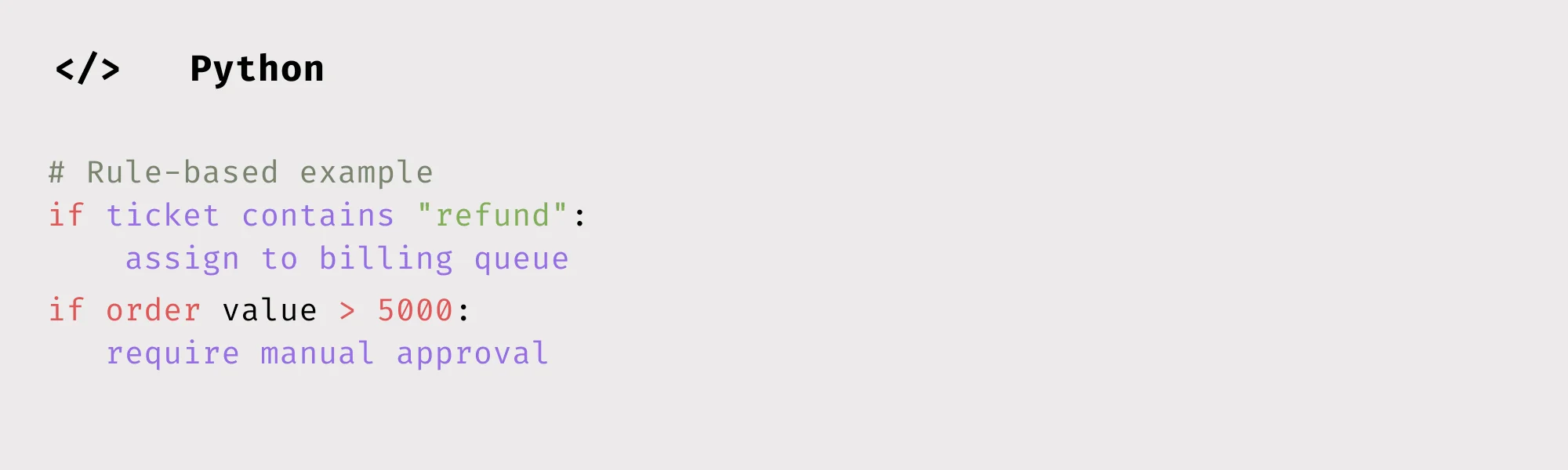
The outcome is predictable. Every time.
An AI agent interprets context. It may decide a message implies a refund request even if the word “refund” isn’t present. The AI still gets it, but it comes with uncertainty.
For small teams operating with limited engineering capacity, that uncertainty is expensive:
- Monitor more
- Test more
- Handle more weird cases
- Deal with more unexpected stuff
If you swap out a reliable system for an AI system without understanding this shift, you end up with more work, not less.
The issue isn’t that AI can’t be trusted. It’s just that it’s built to solve a different kind of problem.
Before deciding between AI agents and traditional automation, it helps to understand where deterministic systems still outperform intelligent ones.
What Traditional Automation Still Does Better
AI agents are great when you need flexibility.
They’re good at handling fuzzy situations and making sense of things that aren’t spelled out, but sometimes flexibility just isn’t what you want.
Deterministic Workflows
Traditional automation excels when the rules are clear and stable.
If a process is expressed as:
- If X happens → do Y
- If conditions A and B are true → trigger C
Then you’re dealing with a deterministic system.
Examples:
- Routing support tickets based on categories
- Sending reminders after a fixed time
- Applying discounts when conditions are met
- Flagging transactions above a certain threshold
In these situations, adding AI doesn’t help. It just makes things less predictable.
Deterministic systems are easier to test because the output is known in advance. They are easier to debug because you can trace the exact rule that fired. They are easier to maintain because the logic is explicit.
With AI agents, the reasoning is embedded inside a model.
Even if it mostly acts the same, you can’t guarantee it will behave the same every time.
Predictability and Compliance
Some workflows exist in environments where variability is unacceptable.
Think about:
- Financial approval systems
- Regulatory reporting
- Access control policies
- Data retention policies
In these cases, “usually correct” is not good enough.
AI agents work on probability. They generate outputs based on likelihood, not certainty.
Even with guardrails, they can produce edge-case behaviors that weren’t explicitly anticipated.
By contrast, Traditional automation does exactly what it’s told. No improvising, no guessing, no filling in the blanks. That’s the whole point in systems where compliance matters. A bit of rigidity isn’t a flaw. It’s a strength.
Lower Maintenance and Operational Overhead
AI systems require ongoing supervision. Models may drift. Prompts may need adjustments. Weird cases emerge over time. Costs fluctuate depending on how much you use them. Monitoring becomes a continuous requirement rather than a one-time setup.
Traditional automation is comparatively static. Once the logic is implemented and tested, it rarely changes unless your business rules change.
That difference is huge, especially if you’re a small team without machine learning experts or infrastructure people.
If you go with AI, you’re signing up for things like:
- Building evaluation pipelines
- Setting up observability tools
- Planning error-handling strategies
- Monitoring your budget much more closely
Choosing rule-based automation often means committing to none of those beyond standard logging.
The point isn’t that traditional automation is better.
It’s just built for a different kind of problem: the ones with clear rules, little ambiguity, and where being consistent matters.
What Makes AI Agents Fundamentally Different
What actually makes AI agents so different is not just about complexity.
It’s about how they make decisions.
Traditional automation is deterministic. Give it the same input, and you’ll always get the same output.
AI agents? They are probabilistic. The same input can produce slightly different outputs. (OpenAI API documentation).
That architectural difference changes everything.
Deterministic vs Probabilistic Systems
A rule-based automation system follows explicit logic trees:
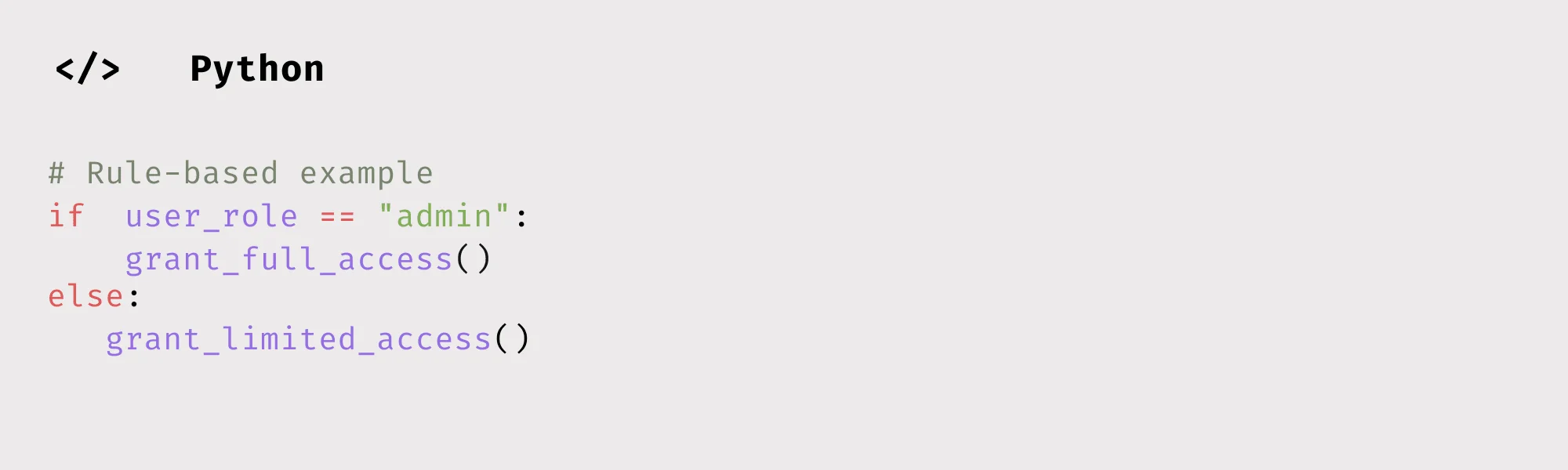
There’s no interpretation layer. The system evaluates a condition and executes a predefined outcome.
An AI agent doesn’t rely solely on hard-coded rules. Instead, they remember past interactions, consider language, and even take hints from history.

Example phrases interpreted as “refund” intent:
- “I’d like my money back.”
- “This didn’t work for me.”
- “Can I undo this purchase?”
AI can pick up on all those as “refund” without being explicitly told to. That’s powerful.
But it also means the system is making its best guess based on what it’s seen before.
Context Handling and Memory
Traditional automation handles every input the same way unless you’ve specifically programmed it to do more.
AI agents can:
- Reference earlier conversations
- Keep track of short-term context
- Chain decisions together
- Shift their responses as situations change
This makes them suitable for workflows like:
- Customer support triage
- Lead qualification
- Content summarization
- Intelligent routing across multiple systems
However, this also introduces complexity. When memory is involved, behavior can evolve in ways that are harder to predict and debug.
Autonomy and Tool Orchestration
AI agents can also act as orchestrators.
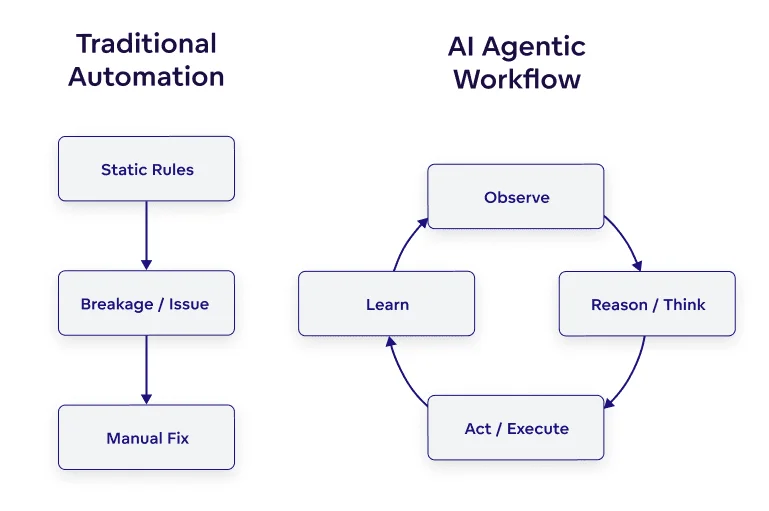
Instead of performing a single action, they:
- Interpret a request
- Decide which tool or API to call
- Execute the action
- Evaluate the result
- Adjust if necessary (Intelligent Automation Case Studies)
Traditional automation just runs through a set list of actions.
AI agents dynamically decide the sequence.
That flexibility lets you build more advanced workflows, but it also means the model and not your rules is in the driver’s seat.
Small teams need to recognize that difference.
An AI agent isn’t just a smarter rule engine. It’s a decision-making layer that sits on top of your systems. And you need to keep an eye on it.
When a Workflow Is Actually Ready for AI
Not every workflow needs an AI agent. In fact, many processes are better off with traditional automation. The key is knowing when AI adds real value and when it just adds complexity.
Here’s a practical checklist to guide decisions:
1. The Task Needs Judgment
Ask yourself: Does the workflow need interpretation or reasoning?
- Rule-based automation works when tasks are predictable.
- AI is useful when the system must make choices with nuance or ambiguity.
Example:
- Sorting incoming support tickets by exact keywords → traditional automation
- Prioritizing tickets based on tone, sentiment, and urgency → AI agent
2. Lots of Edge Cases
- AI shines when workflows encounter exceptions that rules can’t cover efficiently.
- If exceptions are rare and predictable, traditional automation is simpler and safer.
3. High Variability
- If your data or tasks keep changing, AI can adapt without you rewriting rules all the time.
4. The Cost of Mistakes Is Acceptable
- If you’re dealing with compliance or finance, stick with deterministic systems.
5. Adequate Data Is Available
- AI needs data to function effectively. Rule-based automation does not.
If most of these fit your situation, AI agents probably add value. If not, you’re just making things more complicated than they need to be.
Common Mistakes Small Teams Make With AI
Even teams with a lot of experience slip up when they start using AI agents.
Many of these mistakes aren’t about technology. They’re about expectations, planning, and oversight.
Here are the most common pitfalls:
1. Replacing Working Systems Too Early
Just because AI is available doesn’t mean every workflow should be replaced. Many teams abandon stable, rule-based processes for AI that doesn’t actually improve outcomes.
Reality check: If your current setup gets the job done, is reliable, and meets your needs, adding AI might just pile on extra headaches instead of helping.
2. Ignoring Monitoring and Observability
AI systems are probabilistic.
They can drift over time, misinterpret inputs, or produce inconsistent results.
- Teams often assume “set it and forget it.”
- Without monitoring, errors go unnoticed until they affect customers or operations.
3. Underestimating Maintenance Costs
AI agents require:
- Model updates
- Prompt tuning
- Error handling
- Logging and alerts
Teams often don’t realize this is way more work than what Traditional automation needs.
4. Failing to Build Fallback Mechanisms
AI systems should have safe fallbacks for edge cases.
- What happens when the AI misclassifies a ticket?
- What if an AI decision triggers a workflow that breaks downstream processes?
Without solid backup systems, a small slip can turn into a big mess fast. And when that happens, people lose trust.
5. Treating AI Like Magic
Some teams expect AI to automatically solve problems without human guidance.
- AI agents are tools, not autonomous problem solvers.
- They amplify decision-making capacity, but they don’t replace strategy, planning, or oversight.
A Practical Framework for Making the Right Decision
To simplify the decision between AI agents and traditional automation, we can use a framework that evaluates workflow complexity, risk, and resources: C.L.A.R.E. Test (automation decision framework)
- C – Consistency Required: Do you need the same result every time?
- L – Level of Ambiguity: Are inputs ambiguous or depend on the situation?
- A – Accuracy Tolerance: Can you afford a few mistakes, or not at all?
- R – Resource Availability: Does the team have the capacity to monitor, maintain, and improve an AI agent?
- E – Evolution Over Time: Is this workflow likely to change a lot or stay the same?
Using this automation decision framework, small teams can quickly assess whether AI or Traditional automation is the smarter choice.
Conclusion: Choose the Simplest System That Works
AI agents are powerful. They can handle complexity, ambiguity, and evolving workflows. It also brings new headaches: unpredictability, maintenance, and cost.
Traditional automation remains a reliable, low-overhead solution when rules are clear, and consistency is critical.
Smart teams don’t jump on the AI bandwagon just because it’s trendy.
They evaluate:
- The problem they’re solving
- The risk of errors
- The resources they have
- The adaptability they need
By making decisions deliberately rather than following trends, small teams can optimize workflows, save time, and avoid costly mistakes.
Sometimes, the best intelligence is knowing when not to use intelligence at all.